
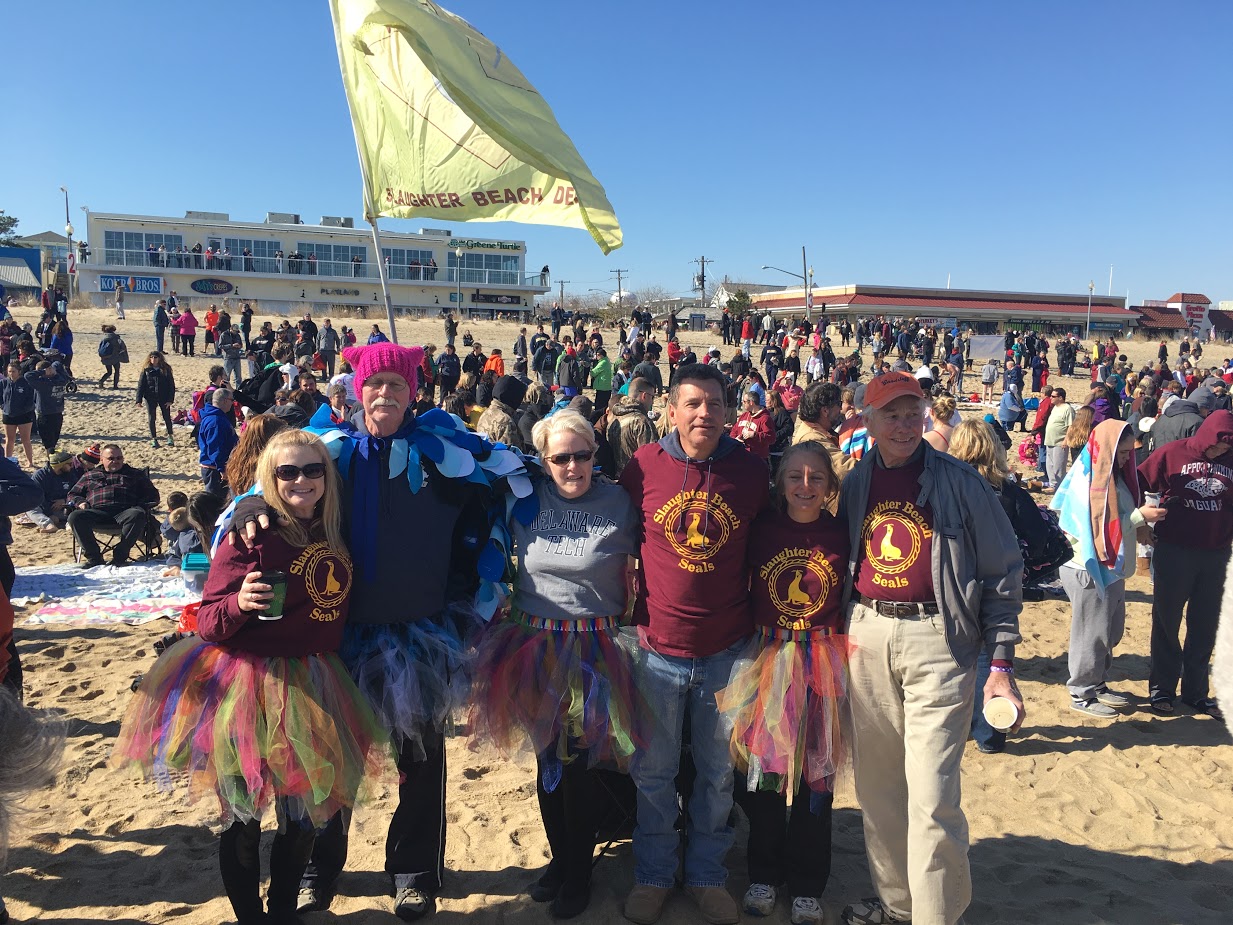
SB Seals at the 2017 Lewes Polar Bear Plunge
The Slaughter Beach Seals, led by Jackson Gingrich, raised a total of $2576 for the Special Olympics. The Seal team ranked 31st out of 289 teams in terms of fundraising. Team members were Jackson, Harry, Gail, Becky, Kelly and Ken.
The Plunge helps 4,000 Special Olympics athletes!!! 3,602 Bears raised $900,000 and counting …
Volunteer Opportunities for Horseshoe Crab Spawning and DuPont Nature Center Opening
Interested in lending a hand. Delaware Nature Society will once again be conducting the Horseshoe Crab Spawning at Slaughter Beach. A training session will be help for in April. Here is information about training and also the spawning dates: training-flyer-word-format-2017-1
Dupont Nature Center will be open April 1st. In March they will be holding a Cleanup day and in April holding a Volunteer Orientation. More information is provide here: dnc
Memorial Fire Co Roast Beef Dinner
The Memorial Fire Co. will be holding a roast beef dinner on Sunday April 2nd from 12:00 to 3:00, the cost is $12. Tickets can be purchased by calling 302-422-4032, must be purchased by 3/19.
Santa Coming to Town on Dec 10th at 7PM
Santa’s Coming to Town on Dec 10th at 7PM. See the flier for more details. Flier
Website Down for Maintenance
This site will be down for maintenance purposes on Sunday, November 20th. This maintenance will happen from approximately 4:00AM to 9:00AM.
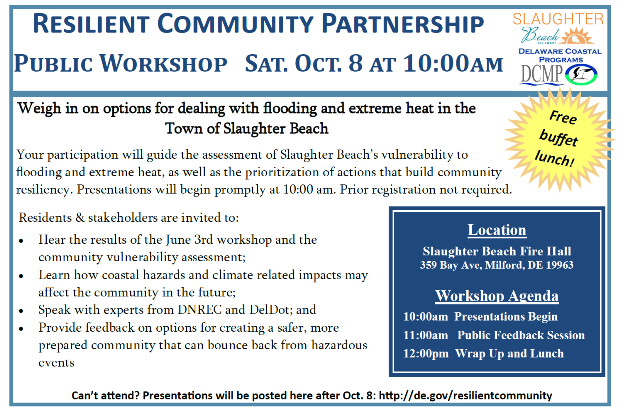
Community Resilient Partnership Workshop Sat. Oct. 8 at 10AM
Delaware Nature Society’s Autumn at Abbott’s Festival
As a final celebration of Abbott’s Mill Nature Center’s 35th Anniversary, we are bringing back our
Autumn at Abbott’s Festival, which was previously held every fall for 24 years. Historically, this festival
has featured a variety of artisan craft demonstrators, live music, children’s activities, hay rides, live animal
shows, and tours of our historic Abbott’s Mill. For the 35th, were raising the stakes by bringing in local
farm vendors, food truck fun, a Dogfish Head beer garden with lawn games, yoga sessions with the
Free Spirited Foundation, an aquatic touch tank with Phillips Wharf Environmental Center’s Fishmobile,
and guided SUP & kayak trips on Abbott’s Pond by Quest Adventures.
Autumn Abbott’s Festival Delaware Nature Society at Saturday, October 15, 9 am – 3 pm
Abbott’s Mill Nature Center
Part of our 35th Anniversary Autumn Celebration Weekend
Abbott’s Mill Nature Center, 15411 Abbott’s Pond Road, Milford, DE 19963 | 302.422.0847 | Info@DelNature.org
Members FREE | Non-members: Adults $5, Children ages 5+ $3
www.DelNature.org/AutumnAtAbbotts
See flyer for more details: delnature-autumn-at-abbotts-flyer-final
Delaware Nature Society’s Meal at the Mill
Meal at the Mill is part of our 35th Anniversary Autumn Celebration Weekend
Where: Abbott’s Mill Nature Center | 15411 Abbott’s Pond Road, Milford, DE 19963 | 302.422.0847 | Info@DelNature.org
When: Friday October 14 at Abbott’s Mill Nature Center, Milford
Guests will arrive at twilight, to enjoy a keg-conditioned cocktail from Dogfish Head while strolling the tree
lined boardwalk and touring our preserved, working grist mill. Then, conjoin for a family-style, three-course
seated dinner under the stars. Our menu will feature delectables grown on Delaware Nature Society’s own
Coverdale Farm Preserve, in Greenville, Delaware with a menu pairing by Abbott’s Grill and Dogfish Head Craft
Brewery ales. Meal at the Mill will highlight the bountiful fall season while honoring the historic and cultural
importance of mills in food production. This dining event brings together conservation-minded people in spirit
of raising funding for the education, advocacy, and conservation activities of Abbott’s Mill Nature Center.
See flyer for more details: delnature-meal-at-the-mill-flyer-1
Restoration work has begun at Mispillion Harbor Reserve
NEWS FROM THE DELAWARE DEPARTMENT OF NATURAL RESOURCES AND ENVIRONMENTAL CONTROL (DNREC)
Contact: Melanie Rapp, DNREC Public Affairs, Melanie.Rapp@delaware.gov, 302-739-9902
Restoration underway along Delaware Bayshore to repair and enhance beaches,
critical wetlands and natural defenses
Projects at Mispillion Harbor, Ted Harvey Conservation Area are reducing flooding, restoring habitat,
improving resiliency and protecting public safety and property
DELAWARE BAYSHORE (Sept. 12, 2016) – Restoration work has begun at Mispillion Harbor Reserve and the Ted Harvey Conservation Area on two key DNREC projects that will repair and restore beaches, critical wetlands and other natural defenses. Both Division of Fish and Wildlife projects protect and restore wildlife habitat, improve coastal resiliency and preparedness to storms, and protect public safety and property by reducing flooding to communities, while enhancing ecotourism and recreational activities along the Delaware Bayshore.
Mispillion Harbor Reserve
Located near the Town of Slaughter Beach in central Kent County, Mispillion Harbor Reserve’s beach, wetlands and adjacent resources have been degraded by Hurricane Sandy and subsequent coastal storms, resulting in the significant loss of habitat for spawning horseshoe crabs and shorebirds.
The Harbor is a major stopover in the Atlantic Flyway for waterfowl and shorebirds, including the federally threatened Red Knot. The birds descend on the Harbor to feed on horseshoe crab eggs before continuing their annual migrations to their Artic breeding ground. Birders and biologists from around the world come to Mispillion Harbor to witness the annual spring spectacle. In 1986, Delaware Bay joined the Western Hemisphere Shorebird Reserve Network as a Site of Hemispheric Importance due to the sheer number of shorebirds that use the Bay as a migratory stopover.
Lindstrom Excavating has begun restoration of the beach and the stone dike. Restoration of the beach includes adding 46,000 cubic yards of sand to the Harbor. The stone dike is being restored with groins which include 12,000 tons of new stone that add height and stability. The stone raises the dike to a level that will better withstand waves and wind from coastal storms, thereby reducing flooding to adjacent wetlands, improving the resiliency of the Harbor to future storms and protecting the navigational channel through Mispillion Inlet, ensuring continued commercial and recreational access to the Delaware Bay.
The project is expected to be completed in April 2017 – in time for the annual shorebird migration. A new video, Mispillion Harbor Restoration Preview, can be viewed on DNREC’s YouTube Channel.
Ted Harvey Conservation Area
Ted Harvey Conservation Area, along the St. Jones River near the Town of Kitts Hummock, is a large coastal impoundment that provides critical habitat for migratory waterfowl, shorebirds, and other wildlife. The impoundment has suffered several dike breaches and subsidence over the years, and malfunctioning water control structures have resulted in flooding of more than 400 acres of habitat.
The project is restoring more than 5,000 feet of dike and replacing two malfunctioning water control structures. About 40,000 cubic yards of soil is being added to increase the average height of the existing dike by 4 feet, improving coastal resiliency and preparedness to storms. The new water control structures will allow the Division of Fish & Wildlife to effectively manage impoundment water levels for wildlife, thereby improving biodiversity and enhancing recreational activities, including waterfowl hunting.
Project contractor Zack Excavating is scheduled to start restoration this month and complete the project by October 2017. As a result, the Ted Harvey South Impoundment and south boat launch parking lot will be closed to the public beginning Sept. 26 and will reopen once the project is completed in 2017. Therefore, the impoundment will be closed for the 2016/17 waterfowl season. Additionally, potential closings may take place for the road leading to the restoration site. Drivers should be aware of heavy truck traffic in the area and follow signs, if the road is closed.
The projects are made possible by two federal grants totaling $6.5 million awarded to DNREC’s Division of Fish & Wildlife from the U.S. Department of the Interior (DOI) through Hurricane Sandy Coastal Resiliency appropriations. Administered by the National Fish & Wildlife Foundation (NFWF), the grants have leveraged additional funding from state watershed stewardship funds, a Wildlife Sport Fish and Restoration federal grant, and Ducks Unlimited (DU). The projects are the result of close cooperation and partnerships among DNREC, the U.S. DOI, the NFWF, DU and Delaware’s Congressional Delegation of Senator Tom Carper, Senator Chris Coons, and Congressman John Carney.
For more information contact Jeremey Ashe, Habitat Restoration project manager, Division of Fish and Wildlife, Jeremey.Ashe@delaware.gov or 302-735-3601 or visit the Delaware Division of Fish & Wildlife Facebook page at www.facebook.com/DelawareFishWildlife
This project is part of DNREC’s Bayshore Initiative, a landscape approach to restore and protect fish and wildlife habitat, increase volunteer participation in habitat stewardship projects, enhance low-impact outdoor recreation and ecotourism opportunities, and promote associated environmentally compatible economic development. In 2011, the Delaware National Bayshore plan received national recognition as one of two Delaware projects included in a 50-state report from the U.S. Department of the Interior outlining some of the country’s most promising ways to reconnect Americans to the natural world.
Amended Delaware Regulations Governing Beach Protection and Use of Beaches go into effect Aug. 11
Amended Delaware Regulations Governing Beach Protection and Use of Beaches go into effect Aug. 11
(DNREC Press Release)
DOVER (July 22, 2016) – Final amendments to Delaware’s Regulations Governing Beach Protection and the Use of Beaches – that implement legislative changes to the state’s Beach Preservation Act and clarify and codify the process for construction to help preserve the state’s fragile dune and beach system – will go into effect Aug. 11.
The amendments, pursuant to 7DE Admin. Code §5102, were approved July 15 in an order signed by DNREC Secretary David Small, and will be submitted to the State of Delaware’s Register of Regulations for publication Aug. 1.
Delaware’s Beach Preservation Act was passed in 1972 as the General Assembly recognized that Delaware’s beaches were rapidly deteriorating due to a combination of natural processes and continuing encroachment. DNREC was charged through the act to enhance, preserve and protect the public and private beaches of the state and to mitigate beach erosion and minimize storm damage.
A significant amendment to the Beach Preservation Act was passed by the General Assembly in 1996, requiring DNREC to take additional steps to minimize the impacts on the beach and dunes from any construction that took place seaward of the building line established to protect coastal dunes. The methodology for achieving the objective stated in the legislation was developed by the Department as a set of procedures and guidance that became known as “The Four-Step Process.” This guidance had not been incorporated into Delaware’s beach regulations until now.
“Delaware’s beaches and dunes are among our most vulnerable natural resources, a significant driver behind our state’s economy and critical to protecting our coastal areas,” said Secretary Small. “Incorporating the Four-Step Process into the regulation, as it has existed and been applied during the past 20 years, assures consistency, transparency and certainty for the public. It also allows the development and redevelopment of these sensitive areas to occur in an orderly and equitable fashion.”
Current Regulations Governing Beach Protection and the Use of Beaches were adopted in 1983. Since then, several amendments have been made to Delaware’s Beach Preservation Act that had not yet been incorporated into the regulations, along with several procedures used over the years to guide DNREC’s mission as stated in both the Beach Preservation Act and the state regulations for beach protection and use.
Notable proposed changes include:
- Changes to the Beach Preservation Act (Del. Code Title 7, Ch. 68) define a “Regulated Area,” which requires formal approval for construction activities for the first three buildable lots landward of the Mean High Waterline. “Regulated area” is the specific area within the defined beach that DNREC is directed to regulate construction of, to preserve dunes and to reduce property damage. The regulated area shall be from the seaward edge of the beach to the landward edge of the third buildable lot in from the mean high water line. This revision expands the amount of lots required to get approval in some areas and reduces it in others. Changes to the Act mandated this change in the regulations.
- The Regulations incorporate amendments to the Beach Preservation Act (Del. Code Title 7, Ch. 68), which direct DNREC to consider the effects of beach nourishment, where maintained to engineering standards, when existing houses located seaward of the Building Line are being reconstructed after being destroyed by an “Act of God or other accidental event.”
- Placement and approval of temporary structures are directly addressed in the revised regulations. The placement of temporary structures related to an event lasting 72 hours or less will be exempt from getting approval.
- The Four-Step Process for requiring proposed structures seaward of the Building Line to minimize encroachment onto beach and dunes, which is currently Department policy, is incorporated into the revised regulations.
Secretary’s Order 2016-WS-0023 about the amended regulations, as signed by Secretary Small, can be found here: BEACH Reg Amendments 2016 Sec Order-2 Paper or electronic copies of the regulations may be requested by contacting DNREC’s Division of Watershed Stewardship’s Shoreline & Waterway Management Section at (302) 739-9921.